
By Philipp Kunze, Vice President Business Development and Sales Europe
Germany’s Renewable Energy Sources Act (EEG) mandates approximately 99 GW of new solar capacity needs to be built by 2030—an unprecedented rate of deployment that necessitates a new approach to utility-scale solar projects.
To date, Germany’s growth in utility‑scale solar has largely been via fixed-tilt racking, but an analysis by the Institute of Energy Economics at the University of Cologne (EWI) makes a compelling case for a switch to solar trackers.
The EWI report, “Comparative analysis: Value of tracking solar systems and fixed-tilt solar systems,” compares two representative PV system designs for the year 2024, focusing on three discrete dimensions:
generation and market pricing,
net system value, and
market value relative to grid connection capacity.
The result: tracker systems deliver a 108 percent higher net system value than fixed-tilt systems.
The authors note that their results are based on typical generation profiles and actual day‑ahead market prices from 2024. The analysis also takes into account real‑world factors such as increased land usage and lease costs for tracking relative to fixed tilt, underscoring the practical relevance of the results.
Calculating Net System Value

EWI approximates net system value through a three-part methodology:
Start with the market value of the electricity generated.
Subtract the annualized full costs of the system, consisting of the direct capital costs of the PV system (including depreciation and interest), the grid connection to the grid connection point, and the operating and leasing costs.
Subtract grid costs, including costs incurred by systems behind the grid connection point.
The result is the net system value.
Generation and Value Benefits of Solar Trackers vs. Fixed Tilt

EWI’s study shows that tracking systems achieve roughly 29 percent more full-load hours annually than fixed counterparts. But more critically, a tracker’s output is spread more evenly across the day—particularly in the early morning and late afternoon “shoulder hours” when electricity demand and market prices are typically higher.
This temporal advantage results in a 43 percent higher market value for tracker-generated electricity on the day-ahead market.
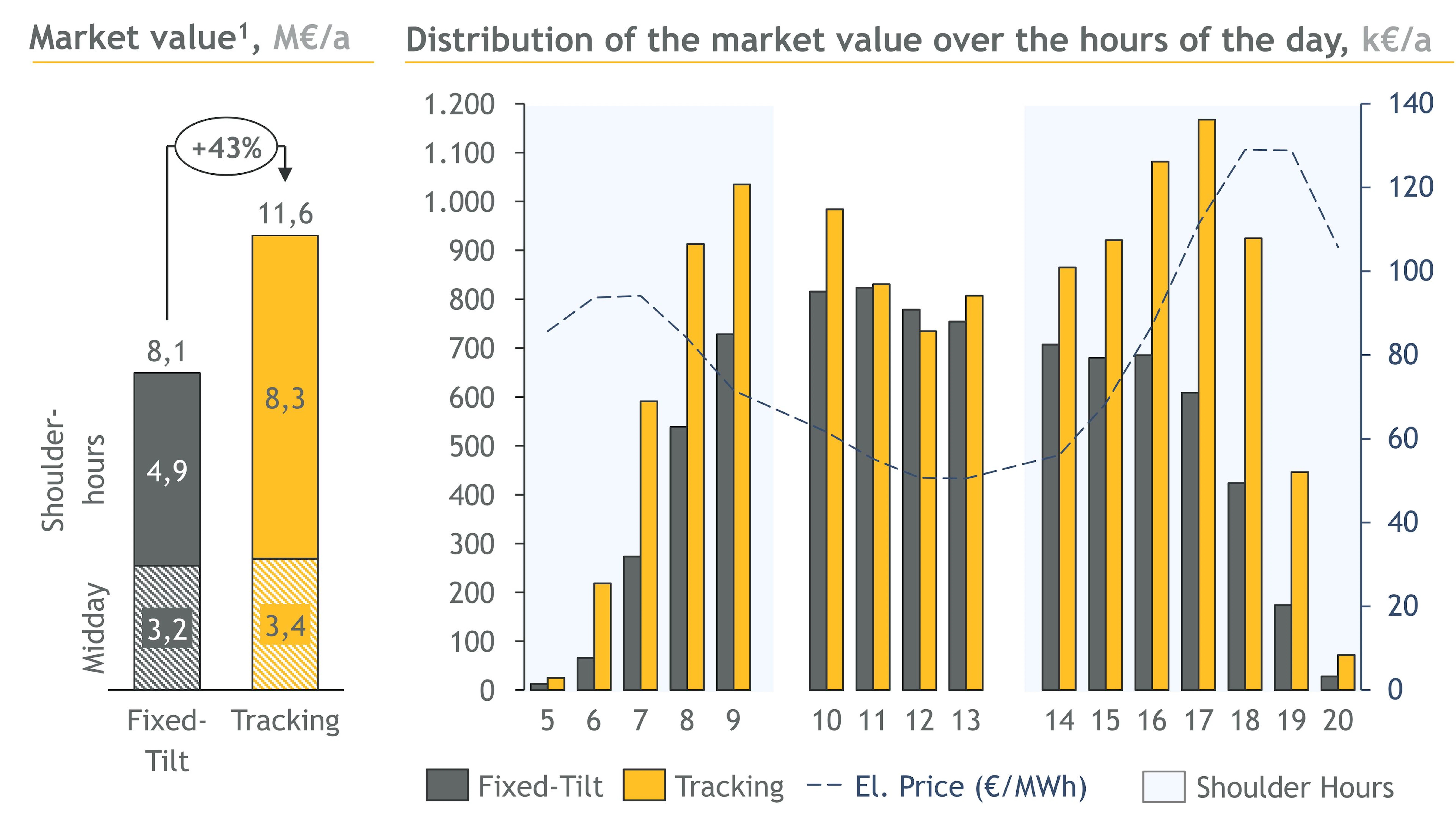
This production profile also aligns better with system needs. Fixed-tilt systems contribute further to sharp midday peaks that can depress prices and strain infrastructure. In contrast, the flatter curve of tracking systems reduces pressure on the grid and enhances the effective use of limited connection capacity.
This finding has immediate implications and calls for a change in priorities towards energy value and grid compatibility over simple nameplate capacity for project design and public planning especially in Germany but also anywhere else. With its EEG adaptation from 2023 not renumerating PV systems under FiT anymore when electricity prices are negative, as well as the currently expected change in the framework for “Netzentgelte” (grid charges), the German government is paving the way for more PV tracker projects in Germany.
By prioritizing trackers over fixed tilt to achieve the EEG targets by 2030, EWI estimates the net system value of trackers could provide grid cost savings of around €3 billion.
Layering In Advanced Controls
At Nextpower, with 150 GW deployed worldwide as of October 2025, we’ve seen firsthand the performance advantages of tracking systems over fixed tilt mounts.
We also know that the advantages of tracking can be enhanced further through an advanced control system. Our TrueCapture® system works in combination with our independent-row hardware to continually calculate and adjust tracker angles in varied ground conditions on a row-by-row basis. This can unlock additional energy during the day’s shoulders, which is key to EWI’s analysis, as well as in diffuse light conditions. Independent engineers have confirmed the bankability of TrueCapture, validating up to 4 percent additional energy compared to standard backtracking.
In constrained or high-value markets, this performance gain translates directly into improved project economics.
Conclusion
The path to 2030 in Germany will be defined not only by how much solar is deployed, but by how intelligently it integrates into the broader system. EWI’s analysis offers a compelling argument for shifting from a capacity-centric to a value-centric model—one in which net system value becomes a guiding principle for renewable energy project design, permitting, and investment.
As Germany and the broader European market continue their rapid energy transition, solar trackers will play a critical role—not just in meeting deployment targets, but in delivering renewable energy in the most economically and operationally effective way.
Be sure to read the full EWI analysis here in its original German version.