
As utility-scale solar scales, the industry is looking harder at the oft-overlooked parts of the solar plant to shore up and localize supply chains, streamline installation for EPCs, and reduce risk for owner operators. Module frames sit at the center of that conversation: they’re a ubiquitous, historically unchanged component that influences how fast projects get built, how well modules withstand real-world loading and weather conditions, and how resilient supply chains are when timelines are tight.
Steel solar module frames are set to change all of that. By reducing structural risk, localizing manufacturing, accelerating installation, and significantly cutting embedded carbon emissions compared to legacy aluminum frames, Nextpower advanced steel frames reposition the module frame from a passive component to a strategic structural element for a solar power plant.
For developers, U.S.-made steel frames also add six percent to a tracker project’s domestic content calculation, according to U.S. Treasury Department guidance.
In this Q&A with Jenya Meydbray, general manager of Advanced Frames at Nextpower, we dig into how steel frames — backed by the scale and engineering know-how of Nextpower — provide a meaningful upgrade over legacy imported aluminum frames, and what the future holds for steel frames in terms of market adoption and continued innovation.
Meydbray brings two decades of deep technical and commercial experience across solar reliability, manufacturing, and project deployment. He began his career at SunPower in 2006 as a reliability engineer, then founded PVEL in 2010 — helping shape how the industry evaluates and de-risks module performance. Across testing, bankability, and project development, Jenya has spent his career at the intersection of inspecting “what fails in the field” and “what should be designed differently upstream.” This is the lens he brings to Nextpower’s steel frame division.

Q: What brought you to Nextpower to lead the steel frames division?
Jenya Meydbray: For starters: Dan Shugar. He was my first investor and board member at PVEL. I first met him at SunPower—he was the president and I was just starting—but that’s where the connection started. Dan has done more for this industry than probably any one human, so I have an enormous amount of respect for him.
Organizationally at Nextpower, there’s a clear vision and proven track record of execution that nobody else has. There are very few organizations with this much solar experience where the cofounders are still together. That speaks volumes.
But beyond that what drew me in was the broader opportunity for steel frames as a product within Nextpower. The industry is still immature: you’re buying individual components from different suppliers and are cobbling them together. The future is a co-engineered, co-optimized system. People recognize that’s the path, but nobody is executing on it like Nextpower.
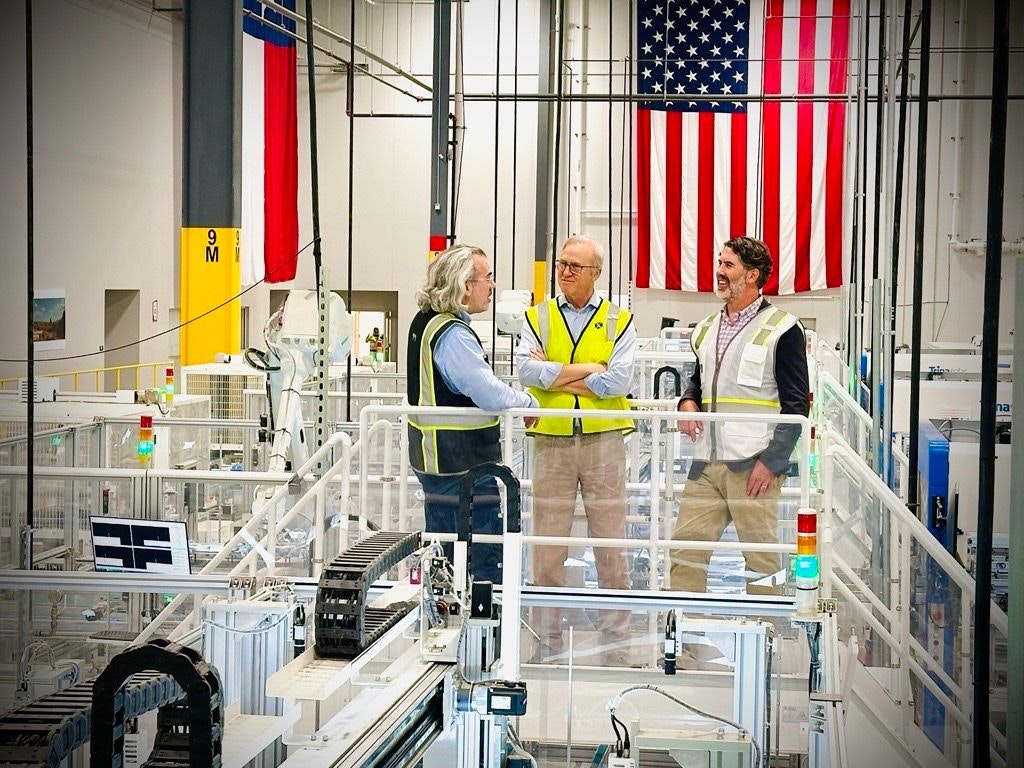
Photo: Dan Barcelo, CEO T1 Energy, Dan Shugar, founder and CEO Nextpower, Ross Heimann, VP Engineering at Clearway.
Q: Can you explain how the steel module frame improves structural reliability?
Jenya Meydbray: First, let’s talk about what happens today. You take an aluminum frame, and you put a steel structure essentially underneath it and mount it. It’s inefficient.
Meanwhile, modules have gotten larger over the years. Glass has gone from 3.2 mm thick and tempered to 2.0 mm thick and untempered, because you can’t economically fully temper glass that thin. When glass is that thin, it’s harder to manufacture consistently, so you get a broader distribution of mechanical properties. With 2.0 mm glass on the front and back, it’s much more fragile.
The aluminum-framed, large floppy modules flex under snow loads and wind loads. Beyond a certain amount of flex, glass shatters. The module frame allows the whole thing to deflect, and steel provides more structural support. Under the same pressure, a comparable steel frame versus aluminum will deflect about one-third as much. It supports the glass better and reduces the risk of breakage in those scenarios. You can make an aluminum frame stronger, but it has to be thicker—and that costs more. A tough sell when module manufacturers are under extreme pricing pressure.
Taking all of that into account, the rational direction is stronger steel frames. They reduce the risks of large-format modules in high-winds, while also being more compatible with the steel tracker structure underneath.
Q: How else are steel frames differentiated versus legacy imported aluminum frames?
Jenya Meydbray: One value proposition for module manufacturers in the United States is the potential to domestically source a component they’ve always had to import and hold in inventory. Aluminum frames are coming from Asia and sitting on a boat for more than 6 weeks. This means U.S. module manufacturers have to maintain a massive inventory of frames.
The Nextpower steel frame is the only way to change that. Steel manufacturing capacity in the United States dwarfs aluminum extrusion capacity. Since steel manufacturing is more abundant, there is much more potential for establishing robust, regionalized steel frame supply chains. This also increases the likelihood of steel frame production lines opening up closer to a module manufacturing facility. That would open up the door for shorter lead times for manufacturers and a lower carbon footprint related to logistics.
We’re not there yet, but you can see the possibilities for steel to remake solar module supply chains.

Photo: T1 Energy 5G facility in Dallas, Texas.
Q: How can Nextpower take steel module frames to the next level?
Jenya Meydbray: Nextpower acquired Origami Solar Inc. in 2025, and the two were a perfect match: Origami brought steel frame IP and Nextpower brings its solar engineering expertise and manufacturing scale.
Making a module frame with steel is harder because you must take a sheet of steel from a coil, feed it into a roll-forming line, and then fold it into a very intricate shape. Origami Solar, hence the name, figured it out, and developed IP around it. The result is a steel frame with the same profile as an aluminum frame for frictionless adoption in current module manufacturing, but it’s stronger because it’s steel.
Nextpower is among the largest steel buyers in the United States, and we have the most robust supply chain of any solar component manufacturer — having opened or expanded over 25 manufacturing facilities since 2021. Nextpower also brings a wealth of structural and mechanical engineering knowledge for solar trackers. This gives us the ability to co-design and optimize the key structural elements of a solar system under one team to maximize system performance and minimize cost.

Q: How are we engaging with module manufacturers on steel frames?
Jenya Meydbray: We’re selling directly to the OEMs—T1 Energy and JinkoSolar (U.S.) Inc. are the first examples. They’re our customers. We’re supplying them frames in multi-year, multi-GW agreements.
Module manufacturers are rightfully skeptical of any new component because they are pitched by everyone, and they take on a lot of risk. A small company selling into module manufacturers is a heavy lift. Nextpower is a much different story. We have the ability to co-optimize frame designs to meet their needs, exemplified by our first two supply agreements. We are supplying multiple variants that suit mass-market requirements, extreme weather scenarios, and extra-large format modules. It really is just the beginning.
We’re also talking to developers, EPCs, banks, and IEs—the stakeholders who build the economic model, the risk model, and the structural engineering around projects.
Q: Steel frames lower the embedded carbon emissions of a module. Why is that?
Jenya Meydbray: It comes down to the energy required to manufacture the raw material. Aluminum manufacturing is highly energy intensive. Aluminum uses electrolysis— an energy-intensive process to converts alumina into metal. Steel production, by contrast, uses a thermal process that has a much lower energy intensity. As a result, Nextpower steel frames reduce carbon emissions vs. imported aluminum frames by up to 80 percent.
The U.S. steel industry in general is continuing to drive down carbon emissions, which leads to lower carbon components. One example is Nextpower’s NX Horizon® low-carbon tracker solution, which utilizes recycled steel via electric arc furnace steelmaking to source key components. This reduces the embedded carbon of a tracker by up to 42 percent compared to traditional trackers.
Q: Why else should we be excited about steel frames? What does the future hold?
Jenya Meydbray: Frames haven’t changed for 50 years. The same aluminum frame on the 65-watt module looks like the frame on a 650-watt module today. It’s extruded aluminum. To some extent it was forgotten bill-of-materials part until Nextpower identified the opportunity to acquire Origami Solar.
Now, the Nextpower steel frame is poised to be a crucial point of innovation for the next generation of utility-scale power plants, and the opportunity goes beyond structural performance.
Module installation is the largest single labor component when building a solar power plant. Nextpower is the no. 1 tracker company in terms of global market share. With steel frames, Nextpower can add features that make the tracker installation process substantially more efficient.
We’re just at the start, but we have a roadmap to accelerate production and installation velocity.
Read the Nextpower Advanced Steel Frames datasheet or request a quote to learn more.